Reference architecture teardown: from diagram to starter code to compliance matrix
Most reference architectures die the week they're published. Here's a teardown that keeps them alive

Throughout my career as an Enterprise Architect, I’ve reviewed dozens of reference architectures. The pattern is the same almost every time. Someone spends 6 weeks producing a beautiful diagram, gets executive approval, distributes a PDF, and within 90 days nobody is looking at it. Teams build whatever they were going to build anyway. The architecture review board rubber-stamps things that don’t match the reference because enforcing it would block delivery.
The problem is structural. A reference architecture that exists only as a diagram is a suggestion. Teams need 3 things from a reference architecture before they’ll actually follow it: a diagram they can navigate in under 60 seconds, starter code or templates that eliminate the “where do I begin” problem, and a compliance matrix that connects architecture decisions to audit requirements. Diagram, code, matrix. Three layers. Skip one and the reference architecture becomes shelf-ware.
This post tears down each layer: what it contains, how to build it, and where it breaks.
Layer 1: the diagram (and why most of them fail)
A reference architecture diagram is a map. Its job is to answer one question fast: where does this thing I’m building fit in the system?
Most diagrams fail because they try to answer every question at once. You get a single poster-sized image with 47 boxes, 12 color codes, and a legend that requires its own legend. An architect can read it. A developer building a new payment service can’t find the payments domain without a 20-minute walkthrough.
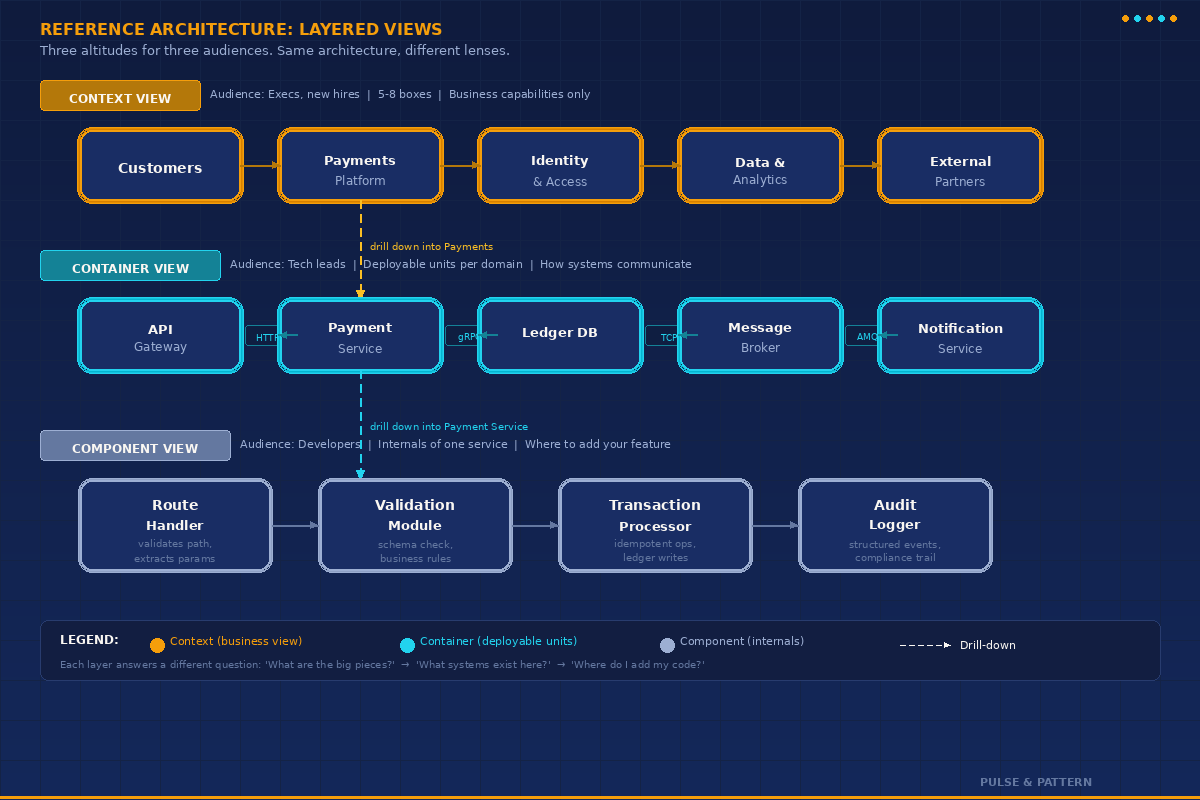
The fix is layered views. One diagram, multiple altitudes.
Context view - (for execs and new hires): 5-8 boxes. Major domains. Business capabilities. No technology names. The question it answers: “what are the big pieces and how do they relate?”
Container view (for tech leads): each domain expanded into deployable units. Databases, APIs, message brokers, CDNs. The question it answers: “what systems exist in this domain and how do they communicate?”
Component view (for developers): one container expanded into its internal parts. Modules, services within a service, key interfaces. The question it answers: “where in this codebase do I add my feature?”
This layering follows Simon Brown’s C4 model. You don’t have to use C4 formally, but if your reference architecture doesn’t offer at least 2 altitude levels, it’s serving one audience and alienating everyone else.
Junior takeaway: when someone hands you a reference architecture, ask which altitude you’re looking at. If the answer is “it’s all in one diagram,” that’s the first problem to fix.
Senior takeaway: the diagram layer is a communication tool, not a specification. If teams are debating architecture decisions by pointing at diagram boxes, the diagram is doing too much work. Push those decisions into the code layer (layer 2) or the compliance matrix (layer 3) where they’re enforceable.
Layer 2: starter code (the adoption multiplier)
Here’s a truth that took me years to accept: developers don’t read architecture documents. They read code. They clone repos. They copy templates.
If your reference architecture doesn’t ship with starter code, you’re asking every team to independently interpret a diagram and make dozens of micro-decisions about folder structure, API conventions, authentication patterns, logging format, error handling shape, and deployment config. They’ll make different decisions. You’ll spend the next 2 years trying to re-converge what diverged in month 1.
What starter code actually means in practice:
Repository templates. A cookiecutter, Yeoman generator, or plain GitHub template repo that scaffolds a new service matching the reference architecture. The template encodes decisions: here’s where config goes, here’s the logging library, here’s how you call the auth service, here’s the health check endpoint that ops expects. I’ve seen teams cut onboarding time for new services from 2 weeks to 2 days with a well-maintained template.
Interface contracts. OpenAPI specs, protobuf definitions, AsyncAPI specs for event-driven systems. These aren’t documentation. They’re the machine-readable version of “this is how systems in this architecture talk to each other.” If your reference architecture shows an arrow between two boxes, there should be a contract defining what travels along that arrow.
Infrastructure-as-code modules. Terraform modules, Helm charts, CloudFormation templates that encode the deployment topology from the diagram. A team building a new service shouldn’t be deciding which VPC, which load balancer config, which logging pipeline. Those are architecture decisions, not team decisions. Encode them.
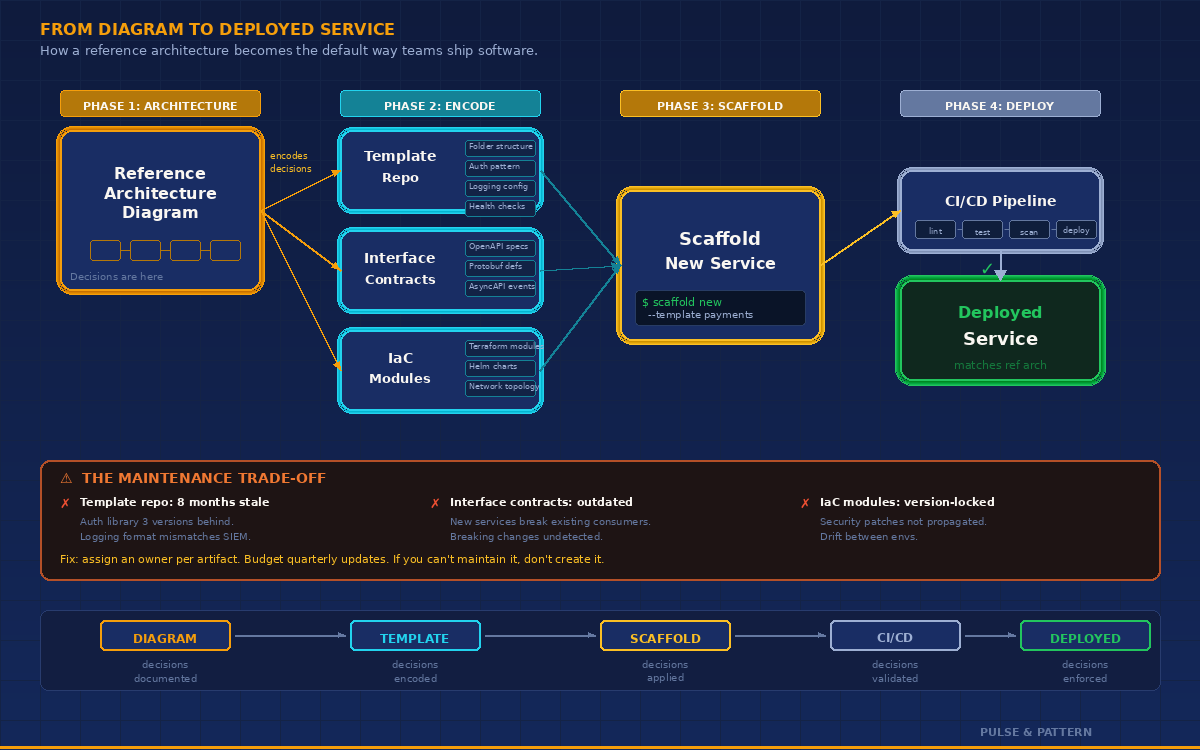
The trade-off with starter code is maintenance. A template repo that hasn’t been updated in 8 months is worse than no template at all, because teams will scaffold from it, ship to production, and then discover the auth library is 3 versions behind and the logging format doesn’t match what the SIEM expects. Assign an owner. Budget time for updates quarterly at minimum. If you can’t commit to maintaining the templates, don’t create them. (~60% confidence this is the right threshold; some orgs can get away with semi-annual updates if the stack is stable.)
Junior takeaway: if you’re starting a new service and there’s a reference architecture, ask if there’s a template repo. If there is, use it. If there isn’t, that’s useful information about how seriously the org takes the architecture.
Senior takeaway: the template repo is the most impactful artifact in the entire reference architecture. It’s where decisions actually get enforced. Invest more time here than in the diagram.
Layer 3: the compliance matrix (connecting architecture to audit)
This is the layer most architecture teams skip. It’s also the layer that determines whether your reference architecture survives contact with a regulator, an auditor, or a risk review.
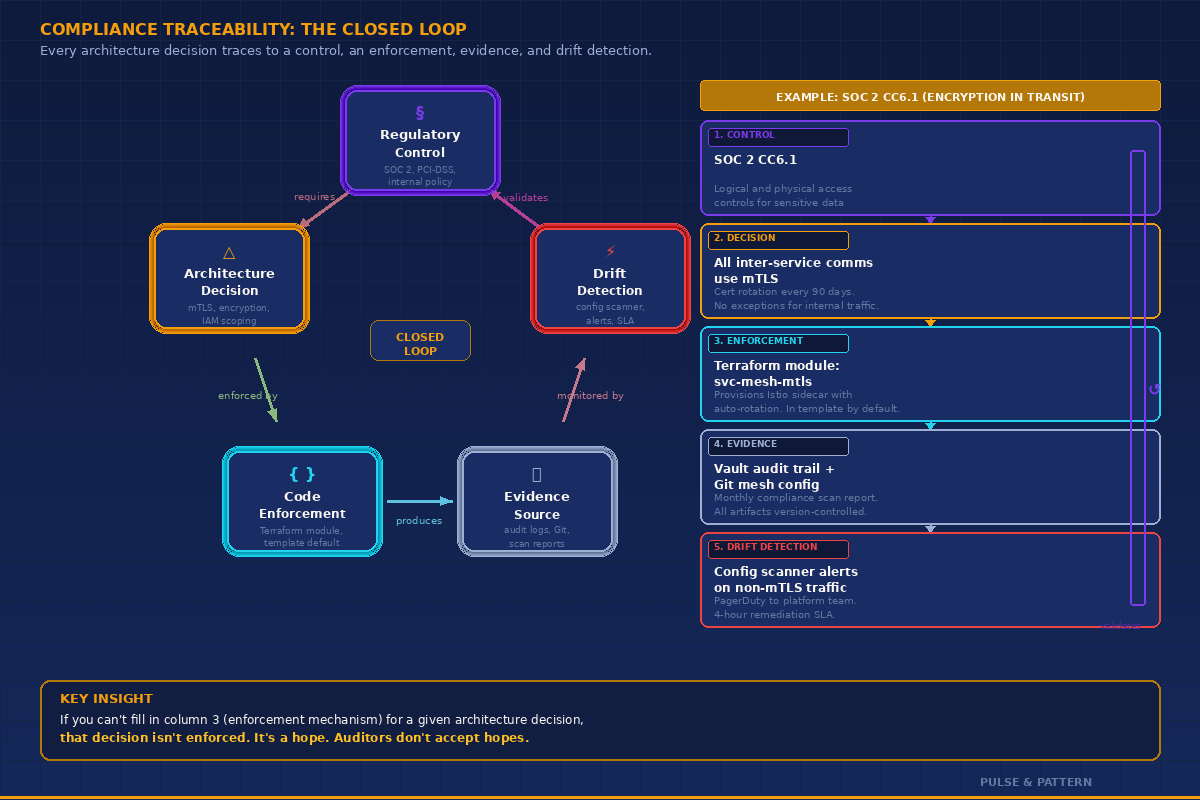
A compliance matrix maps architecture decisions to regulatory or policy requirements. Each row says: “this architecture choice satisfies this control.” It’s the bridge between what the architecture team built and what the compliance team needs to prove.
In financial services, this is where SOC 2 controls, PCI-DSS requirements, OCC guidance, and internal risk policies connect to actual system design. The auditor asks: “how do you ensure data at rest is encrypted?” The compliance matrix points to the architecture decision (all data stores use AES-256 with KMS-managed keys), the starter code that enforces it (the Terraform module that provisions storage with encryption enabled by default), and the monitoring that detects drift (a config scanner that flags unencrypted storage within 15 minutes).
What the matrix contains, practically:
Column 1: control ID. The regulatory or policy reference. SOC 2 CC6.1, PCI-DSS 3.4, internal policy ISEC-014. Whatever your auditors cite.
Column 2: architecture decision. The design choice that addresses the control. “All inter-service communication uses mTLS. Certificate rotation every 90 days.”
Column 3: enforcement mechanism. How the decision is enforced in code. “Terraform module `service-mesh-mtls` provisions Istio sidecar with auto-rotation. Template repo includes the module by default.”
Column 4: evidence source. Where the auditor finds proof. “Certificate rotation logs in Vault audit trail. Mesh config in Git. Monthly compliance scan report from [tool].”
Column 5: drift detection. What happens when reality doesn’t match the architecture. “Config scanner alerts on non-mTLS traffic. PagerDuty alert fires to the platform team. SLA: remediate within 4 hours.”
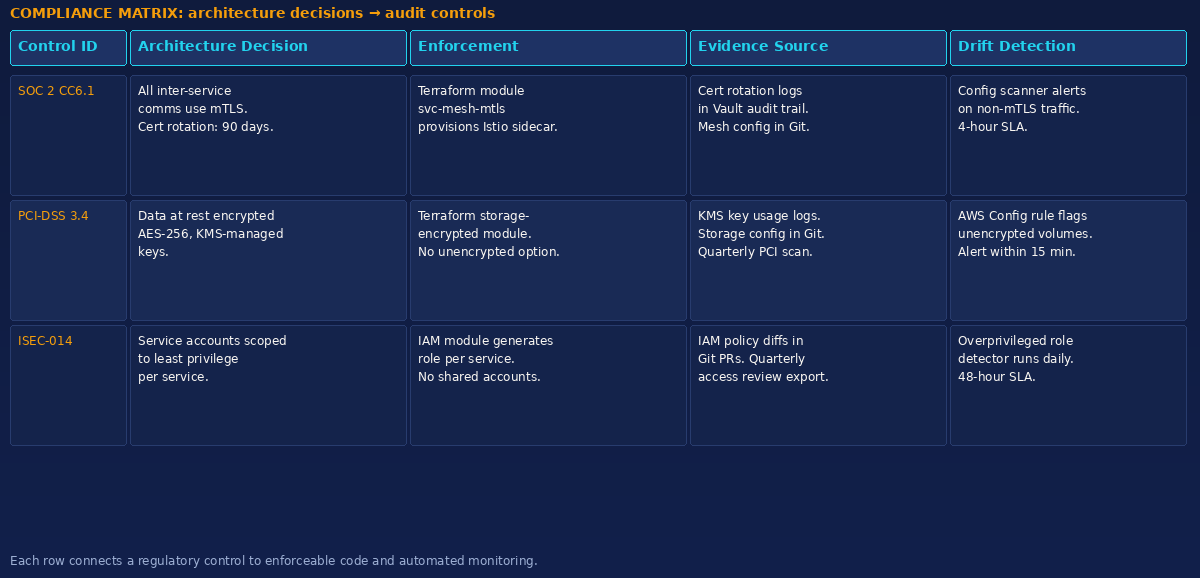
Without this layer, your reference architecture and your compliance program are two separate conversations maintained by two separate teams that sync up once a year during audit prep. That sync is always painful, always incomplete, and always results in someone scrambling to produce evidence that should have been generated automatically.
Junior takeaway: understanding how architecture decisions map to compliance controls is a career differentiator. Most engineers never think about this. The ones who do get pulled into design reviews early.
Senior takeaway: the compliance matrix is the forcing function for making architecture decisions explicit. If you can’t fill in column 3 (enforcement mechanism) for a given decision, that decision isn’t enforced. It’s a hope. Auditors don’t accept hopes.
From the field
At a previous financial services org, I inherited a reference architecture that was 18 months old. Beautiful Visio diagram. 4 pages of narrative. Zero adoption.
Teams had built 11 new services in those 18 months. I audited all 11 against the reference architecture. 2 of them matched. The other 9 had made reasonable but inconsistent decisions about auth, logging, deployment topology, and inter-service communication. Each team had solved the same problems independently. 9 different logging formats. 4 different approaches to service-to-service auth. 3 different deployment patterns.
We rebuilt the reference architecture in 3 layers over about 6 weeks. The diagram got simpler (we cut it from 47 boxes to 12 at the context level, with drill-downs). The template repo took the most time: 3 weeks to build, test, and validate with 2 pilot teams. The compliance matrix took a week, mostly because the compliance team had never been asked to map controls to architecture decisions before. They had their own spreadsheet. We merged it with ours.
6 months later, 8 new services had launched. All 8 used the template. All 8 passed their first architecture review without rework. The compliance team’s audit prep time dropped by roughly 40% (their estimate, not a precise measurement).
The diagram alone didn’t do it. The template repo did the heavy lifting. The compliance matrix kept it funded, because the CISO could point to it when justifying the architecture team’s headcount.
The pattern underneath
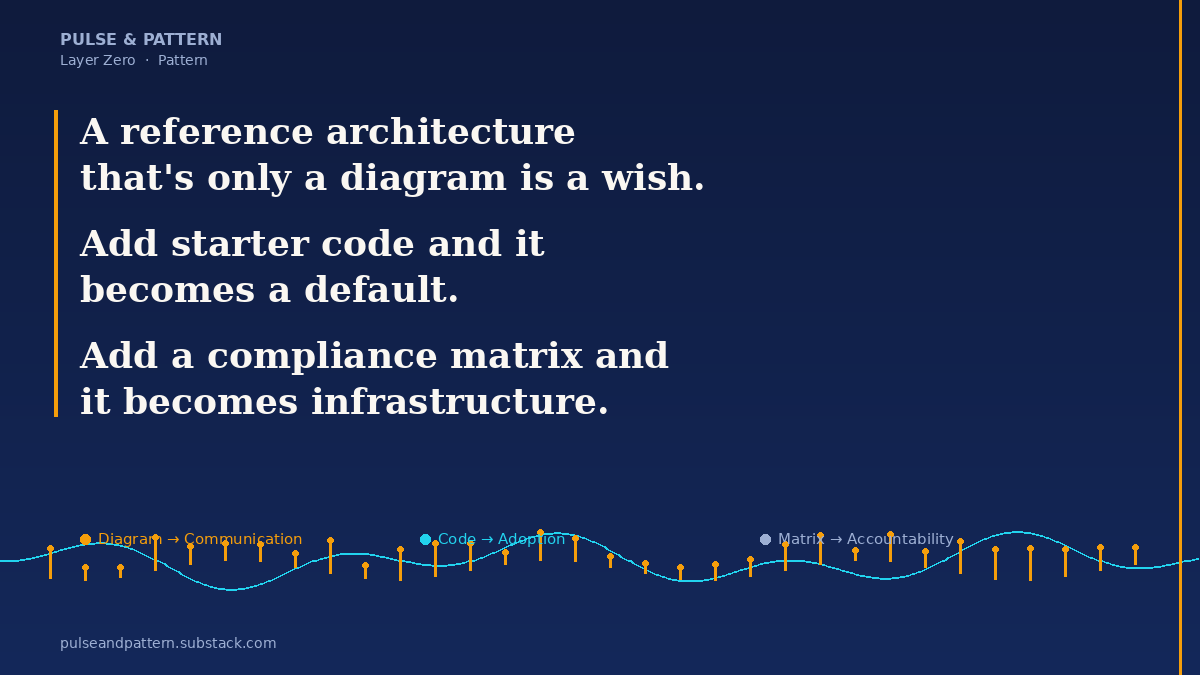
A reference architecture that’s only a diagram is a wish. Add starter code and it becomes a default. Add a compliance matrix and it becomes infrastructure.
Three layers. Diagram for communication. Code for adoption. Matrix for accountability.
Skip the code layer and teams will diverge. Skip the compliance layer and the architecture loses its funding justification the first time budgets get tight.
Build all three and the reference architecture stops being a document. It becomes the way your org ships software.